
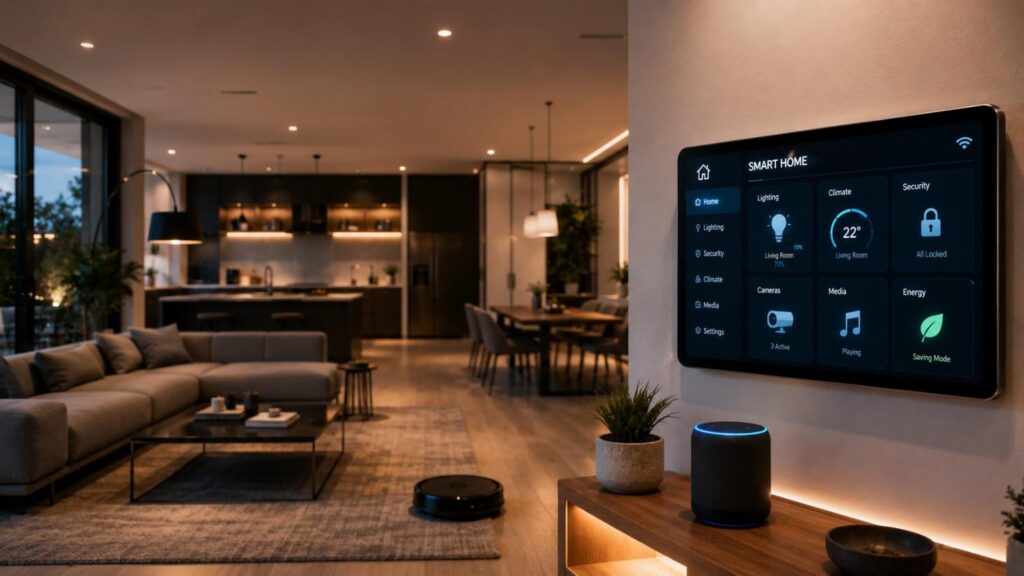
The Future of Smart Home Technology: Trends for 2026
The smart home has spent years evolving from a novelty into a practical part of everyday life. Connected lights, thermostats, locks, cameras, speakers, appliances, and sensors are now familiar to many homeowners. Yet the experience has often remained fragmented. One device might require a dedicated app, another might work only with a particular voice assistant, and a third may need a separate bridge or hub before it can participate in household automation.
That fragmentation is beginning to change. The Future of Smart Home Technology: Trends for 2026 is increasingly defined by coordination rather than simple connectivity. Artificial intelligence is making smart-home control more conversational, Matter is broadening the range of devices that can participate in standardized ecosystems, and Thread is strengthening the networking foundation for low-power connected products. At the same time, energy systems, security cameras, appliances, and robotics are becoming more tightly connected to the wider home environment.
For consumers, this evolution means that “smart” is gradually becoming less about opening an app to control a device remotely and more about reducing everyday friction. A genuinely intelligent home should help coordinate routines, manage energy, interpret useful sensor data, and provide convenient control without forcing residents to understand every technical layer underneath. The most important smart home trends for 2026 therefore focus not only on new devices but also on making the entire connected-home experience more natural, interoperable, secure, and useful.
What Is Changing in Smart Homes in 2026?
Smart homes in 2026 are becoming more integrated at both the device and platform levels. Earlier generations of connected-home products often focused on one capability at a time: a smart bulb could be turned on remotely, a thermostat could be adjusted from an app, and a camera could send motion alerts. Those features remain useful, but the industry is increasingly concentrating on how different products can contribute to a coordinated household environment rather than functioning independently.
Three developments are accelerating this change. First, generative AI is making smart-home interfaces more conversational. Second, open connectivity standards are broadening the number of devices that can communicate through common frameworks. Third, devices themselves are becoming more capable of sensing context, interpreting information, and contributing data to larger automations. Google’s Gemini for Home, Matter 1.5 and 1.5.1, Thread’s expanding certification ecosystem, and Samsung’s AI-connected appliance strategy all provide current examples of this direction.
Industry coverage of current smart home developments also points to a broader shift toward more integrated systems rather than isolated connected devices.
The practical impact is a shift from individual “smart products” toward coordinated smart-home systems. A lock, thermostat, camera, EV charger, appliance, and lighting system become more valuable when they can participate in broader routines and exchange useful information with compatible platforms. For beginners, this means fewer isolated experiences. For experienced smart-home users, it creates new opportunities to build more sophisticated automations without depending entirely on proprietary integrations. The future of smart homes is therefore being shaped as much by cooperation between technologies as by advances inside individual devices.
| Smart Home Trend | Technology Direction | Main Impact | Example Applications |
|---|---|---|---|
| Conversational AI | Natural-language and contextual control | Easier interaction with connected devices | Gemini for Home, Alexa+ |
| Interoperability | Matter and Thread adoption | Better cross-platform compatibility | Smart lights, locks, cameras, sensors |
| Energy Intelligence | Automated energy monitoring and optimization | More efficient household energy use | Solar, EV charging, smart thermostats |
| AI Security | Intelligent camera analysis and alerts | Faster understanding of security events | AI cameras, video doorbells, smart locks |
| AI Appliances | Context-aware connected appliances | More automated household tasks | Smart refrigerators, ovens, robot vacuums |
| Home Robotics | Better perception and navigation | More capable household automation | Robot cleaners and autonomous devices |
From Connected Devices to Coordinated Environments
The first generation of smart-home adoption was largely about connectivity. Consumers could replace traditional bulbs, thermostats, plugs, locks, cameras, or appliances with network-connected alternatives and control them from a phone. That was an important step, but it often resulted in a collection of separate applications and ecosystems. A home could technically contain many “smart” products without those products operating intelligently together.
The next stage is coordination. Instead of treating every device as a separate endpoint, smart home automation increasingly aims to connect device states, sensor information, routines, and user preferences. Leaving home, for example, might involve checking doors, adjusting climate settings, turning off unnecessary lights, enabling security features, and changing the behavior of selected appliances. The value comes from coordinating those actions rather than controlling each product individually.
Interoperability standards are important because sophisticated automation becomes difficult when devices remain trapped inside isolated ecosystems. Matter is intended to provide a common IP-based connectivity framework for supported products, while Thread can provide an efficient networking layer for certain device categories. As these technologies mature, homeowners should gain more freedom to build coordinated environments using compatible products from different manufacturers instead of relying entirely on one company’s product line.
AI Is Becoming the Interface to the Home
Artificial intelligence is changing the way users communicate with connected-home systems. Traditional voice interfaces were convenient, but they often depended on carefully structured phrases and a limited set of recognized commands. Generative AI can interpret less rigid language, maintain conversational context, and handle multi-step requests, making it more suitable for controlling complex household environments.
Google’s Gemini for Home provides a current example. The 2026 Google Home Speaker is designed around Gemini and supports natural-language interaction, multiple instructions within a single request, corrections while speaking, and conversational follow-ups. Google has also expanded continued conversation features so users can interact without restarting every request from the beginning.
This development changes the role of the home assistant. Instead of acting mainly as a remote control activated by voice, AI can become an interface between the person and the underlying automation system. Users can increasingly describe an outcome while the software determines which supported devices or routines are involved. That does not remove the need for careful configuration or permissions, but it makes advanced automation more accessible to people who do not want to learn complex rule-building tools.
Trend 1 — Conversational and Ambient AI Becomes the Control Layer
One of the most important smart home trends for 2026 is the evolution of the household assistant from a simple voice-command system into a conversational control layer. Generative AI makes it possible for smart-home platforms to interpret natural language, understand a sequence of instructions, and maintain more context across interactions. This can make everyday automation easier because residents no longer need to remember exactly how a device or routine was originally configured.
Google and Amazon are both moving in this direction. Google has introduced Gemini for Home across its connected-home strategy, while Alexa+ represents Amazon’s generative-AI evolution of Alexa. Amazon describes Alexa+ as a more conversational and capable assistant, and the company’s current developer resources continue to expand the ways connected devices can work within Alexa-enabled smart-home environments.
The more important trend, however, is not simply better voice recognition. AI is moving toward an ambient role in which the home can combine instructions, device states, sensor signals, preferences, and automation routines into a more coherent experience. That creates enormous potential, but it also makes transparency and control important. Residents should understand what an AI-enabled home can access, which actions it can perform automatically, and how those actions can be changed or reversed. The most successful implementations will make advanced automation feel easier while keeping residents clearly in control.
Natural-Language Control Replaces Rigid Commands
Natural-language control addresses one of the long-standing usability problems in smart homes: users often have to remember the correct command syntax. A voice assistant may understand “turn the bedroom lights off,” for example, but become confused if the user describes the same action in a more conversational or indirect way. That can make voice control feel less natural than the technology promises.
Gemini for Home is designed to reduce this friction. Google’s 2026 Home Speaker supports more natural language, multi-step conversations, multiple commands in a single request, and corrections made while the person is speaking. Google’s wider Gemini for Home rollout also emphasizes continued conversations and the ability to manage connected devices without relying as heavily on memorized phrases.
For smart home automation, the implication is significant. People can increasingly describe what they want instead of programming every detail manually. A user might ask for lighting to be made more comfortable, media to be adjusted, and a routine to be changed in one conversational interaction. The technology still needs clearly defined permissions and compatible devices, but a natural-language interface can make sophisticated automation more accessible to beginners while reducing repetitive control for experienced users.
Homes Become More Proactive, Not Just Reactive
A reactive smart home waits for a direct command. A proactive home uses available context to identify when an action, suggestion, or automation may be helpful. This idea is often described as ambient intelligence: technology operates in the background, using sensor information, device states, preferences, and routines to make the environment more responsive without demanding constant interaction.
Current AI platforms are beginning to move in that direction. Google describes Gemini for Home as being able to understand more about what is happening in the household, while Amazon’s generative-AI direction for Alexa emphasizes more personalized and capable assistance. These platforms are also expanding automation, household management, and connected-device interactions rather than limiting AI to question answering.
Proactive automation must still be designed carefully. An automation that changes temperature, lighting, security, or appliances without clear rules can become frustrating rather than useful. The strongest systems will combine automation with understandable controls, notifications where appropriate, and easy manual overrides. The goal should not be a home that constantly makes decisions for its occupants. It should be a home that reduces repetitive effort while allowing people to decide how much automation they actually want.
Trend 2 — Matter and Thread Make Interoperability More Practical
Interoperability has been one of the smart-home industry’s most persistent challenges. Consumers often discover that devices using the same Wi-Fi network still cannot communicate meaningfully because each product belongs to a different software ecosystem. This creates unnecessary complexity, increases dependence on proprietary apps, and can make switching platforms expensive. Matter and Thread are increasingly important because they address different parts of this fragmentation problem.
Matter is an IP-based smart-home connectivity standard developed through the Connectivity Standards Alliance. Its purpose is to provide a common application framework for compatible products and ecosystems. Thread, by comparison, is a low-power IP-based mesh networking technology designed for connected devices. Apple describes Thread as a mesh network in which Thread-enabled accessories can forward packets for one another, improving coverage and redundancy within the network.
The significance for 2026 is maturity. Matter is adding more device categories and capabilities, while the Thread ecosystem is growing in certified products and components. This does not mean that all interoperability problems have disappeared. Features can still vary by device, manufacturer, platform, and software version. However, the direction is increasingly favorable for consumers. Instead of making every purchase around a single proprietary ecosystem, homeowners can gradually prioritize standards-based compatibility and create a more flexible foundation for future smart home automation.
Matter 1.5 and 1.5.1 Expand the Smart-Home Foundation
Matter has expanded significantly beyond the device categories supported in its earliest versions. Matter 1.5, announced by the Connectivity Standards Alliance on November 20, 2025, introduced support for several high-impact categories and capabilities, including cameras, closures such as garage doors and shades, soil sensors, and more advanced energy-management functions. The update broadened the kinds of connected-home experiences that can potentially be implemented through standardized Matter interfaces.
Camera support was particularly important because video doorbells and security cameras are central to many smart homes but historically depended heavily on proprietary integrations. Matter 1.5 added standardized camera capabilities, while Matter 1.5.1, released on March 31, 2026, focused on improving camera and doorbell experiences. The Alliance describes Matter 1.5.1 as an incremental update aimed at better performance, efficiency, and flexibility for these product categories.
For homeowners, the practical lesson is that the Matter logo is becoming relevant across a wider range of products. It still does not guarantee that every feature will behave identically in every ecosystem, so compatibility should be checked before purchase. Even so, the continued expansion of Matter gives manufacturers and platforms a broader common foundation and can reduce the need for completely separate integrations for every brand.
Thread Becomes a More Important Home Network
Thread is becoming increasingly important because many smart-home devices need reliable networking without the power requirements associated with continuously active Wi-Fi connections. It is an IP-based mesh networking technology designed for IoT devices, meaning compatible products can form a network in which devices help forward traffic. This can improve coverage and create redundancy across the home.
The ecosystem has also expanded significantly. Thread Group announced in November 2025 that more than 1,000 Thread-certified products and components had reached the market. The organization also noted support from major smart-home ecosystem companies including Amazon, Apple, Google, and Samsung. That milestone does not mean every smart-home product uses Thread, but it indicates growing industry investment in the standard.
Consumers should understand that Matter and Thread are not interchangeable terms. Matter is primarily concerned with application-level interoperability, while Thread provides networking. Some Matter devices use Thread; others can use Wi-Fi or Ethernet depending on the device category and implementation. When future-proofing a connected home, understanding both technologies can help buyers evaluate whether a product fits the home’s networking architecture as well as its preferred software ecosystem.
| Technology | Primary Role | Key Benefit | Smart Home Use |
|---|---|---|---|
| Matter | Application-layer interoperability standard | Helps compatible devices work across different ecosystems | Lights, cameras, locks, appliances, energy devices |
| Thread | Low-power IP-based mesh networking | Provides reliable, efficient connectivity for IoT devices | Sensors, locks, lights, and other low-power devices |
| Matter + Thread | Complementary technologies | Combines cross-platform compatibility with efficient networking | Future-ready connected-home environments |
Trend 3 — Energy Management Becomes a Core Smart Home Function
Energy management is becoming one of the most practical areas of smart-home innovation. Earlier smart-energy products often operated independently: a thermostat adjusted heating and cooling, a utility application showed electricity consumption, a solar inverter tracked production, and an EV charger operated according to its own schedule. The emerging smart home is beginning to connect these systems more intelligently so households can make better decisions about when and how electricity is used.
Matter 1.5 represents an important step in this direction. The specification introduced standardized capabilities for exchanging information about energy pricing, tariffs, grid carbon intensity, smart-meter data, electricity generation, and selected EV charging functions. The Connectivity Standards Alliance says these features can allow compatible systems to use standardized information when estimating energy costs, reporting impact, or adjusting operation according to user preferences and tariff conditions.
Recent industry analysis also highlights smart energy management as a defining part of the 2026 connected-home experience, alongside better integration, efficiency, and control.
Other ecosystems are addressing energy coordination as well. Apple’s EnergyKit, for example, provides grid forecast information for apps managing EV charging or smart thermostats and can incorporate certain utility rate-plan information where supported. Its current availability is limited geographically and technically, but it illustrates the broader direction of the market: connected homes are becoming more aware of the relationship between comfort, electricity pricing, grid conditions, and household energy consumption.
Devices Can Respond to Energy Conditions
Traditional smart devices usually operate according to a fixed schedule, manual command, or simple sensor trigger. Energy-aware automation adds another input: the condition of the electricity system itself. A compatible device may eventually be able to consider tariff information, forecast energy pricing, or grid conditions when deciding when to perform an energy-intensive task, provided the user has chosen to enable that behavior.
Matter 1.5 introduced a standardized electrical energy tariff device type and support for sharing information such as real-time and forecasted pricing, tariffs, and grid carbon data. The Alliance says compatible devices can use standardized information to estimate costs or potentially adjust operation according to preferences, tariffs, or applicable requirements. It also expanded smart-metering capabilities for more detailed energy reporting.
For households, the most useful applications are likely to involve flexible loads. Heating and cooling, water heating, EV charging, batteries, and selected appliances can sometimes shift operation without significantly affecting comfort. The important point is not that every device will automatically save money. Actual results depend on equipment, rate plans, behavior, and local infrastructure. The technology simply creates better opportunities to coordinate household energy use intelligently.
Solar, EVs, and the Home Start Working Together
Solar generation, battery storage, and electric vehicles are increasingly becoming part of the connected-home ecosystem rather than being managed as completely separate systems. A home that can understand when solar generation is high, when electricity is expensive, and when an EV needs to be ready for a trip has much more useful information for planning energy consumption.
Matter 1.5 expands the standardized framework available for these scenarios. The specification can incorporate data from energy-producing devices such as residential solar installations, and its EV charging enhancements include state-of-charge information and certifiable support for bidirectional charging capabilities. The Alliance presents these developments as groundwork for more coordinated household energy management and future vehicle-to-grid or energy-sharing scenarios where infrastructure and regulation allow.
Apple’s EnergyKit shows a complementary platform approach by providing grid forecasts for supported EV-charging and smart-thermostat applications. These examples demonstrate how energy intelligence is becoming part of smart-home software architecture. Homeowners should still evaluate regional utility programs, vehicle compatibility, hardware support, and local regulations before expecting advanced energy automation. The trend is real, but practical availability will vary significantly by market and household.
Related Articles
Trend 4 — Smarter Cameras, Access, and Cybersecurity
Security has always been one of the most commercially important smart-home categories because cameras, video doorbells, sensors, smart locks, and alarms solve clear household problems. In 2026, the category is evolving in two directions at the same time. Security devices are gaining more advanced AI and interoperability features, while cybersecurity is becoming increasingly important because connected security systems themselves must be protected.
Matter’s expansion into cameras is a major technical development. Matter 1.5 introduced standardized camera capabilities, and Matter 1.5.1 refined camera and doorbell functionality further. The Connectivity Standards Alliance says the 1.5.1 update improves camera performance and gives devices and ecosystems more flexibility in how camera streams and related experiences are delivered.
At the same time, smart home cybersecurity is becoming a more visible part of product quality. NIST finalized Revision 1 of IR 8259 in April 2026, updating its foundational cybersecurity guidance for IoT product manufacturers. The revision considers cybersecurity across the product lifecycle, including activities before and after products reach customers. For buyers, this reinforces an important principle: a smart security product should be evaluated not only by its camera resolution or AI features but also by how seriously the manufacturer handles updates, account protection, maintenance, and end-of-life support.
AI Makes Camera Data Easier to Understand
Modern security cameras can generate enormous amounts of footage, and the challenge is no longer simply capturing video. It is identifying which events deserve attention. AI can help by interpreting scenes, generating descriptions, identifying patterns, and allowing users to search or review events more efficiently rather than manually examining long timelines.
Google’s Gemini for Home strategy includes AI-assisted features designed to make compatible camera information easier to understand. Google describes advanced capabilities such as camera history search and AI-supported home information within its broader home platform. Matter 1.5 and 1.5.1 simultaneously provide a more standardized technical framework for camera and doorbell functionality, including more flexible approaches to video streams.
The value is not simply “more AI.” Useful camera intelligence should reduce unnecessary alerts and help residents understand important activity more quickly. Privacy is equally important because cameras can collect sensitive household information. Users should review where recordings are stored, which AI features require cloud processing, who can access the footage, and which subscription or account settings affect retention. Smarter analysis should make home security clearer, not make data practices harder to understand.
Cybersecurity Becomes Part of the Buying Decision
Every connected device creates another software component that needs to be maintained. Smart locks, cameras, doorbells, hubs, thermostats, appliances, and routers can all depend on firmware, cloud services, mobile applications, authentication systems, and network configuration. As the number of connected devices grows, cybersecurity becomes an essential part of smart-home reliability rather than a purely technical concern.
NIST’s updated IR 8259 Revision 1 emphasizes cybersecurity activities for manufacturers across the product lifecycle. NIST’s IoT cybersecurity program also highlights issues such as maintenance, support, communications with customers, and end-of-life considerations. These areas are important because a connected product may remain installed for years after purchase.
Before buying a smart-home product, I recommend checking whether the manufacturer explains its software-update practices, security support, and account-protection options. At home, users should keep routers and devices updated, use strong unique passwords, enable multifactor authentication where available, and remove unused accounts or devices. No smart-home platform can eliminate cybersecurity risk completely, but informed purchasing and basic security hygiene can significantly improve the overall security posture of a connected household.
Trend 5 — AI Appliances and Home Robotics Become More Context-Aware
Smart appliances are moving beyond the basic idea of connecting a refrigerator, oven, washing machine, or vacuum cleaner to an app. Earlier connected appliances often focused on remote controls, cycle notifications, diagnostics, or simple scheduling. Those functions remain valuable, but manufacturers are increasingly adding computer vision, conversational interfaces, environmental sensing, recommendations, and deeper integration with household ecosystems.
Samsung’s CES 2026 demonstrations provide a useful example of this shift. The company showed AI-enabled appliances including its Bespoke AI Refrigerator, Bespoke AI Laundry Combo, and Bespoke AI Jet Bot products. Samsung highlighted how cameras, screens, voice interaction, and AI-based features can work together as part of a broader “Home Companion” concept rather than limiting intelligence to one appliance.
The trend should be viewed realistically. Not every household needs AI in every appliance, and additional connectivity can create new questions about price, privacy, subscriptions, and long-term support. The strongest use cases will be those that solve a recurring household problem. AI features that reduce repetitive work, identify useful information, improve maintenance, or coordinate tasks with other home systems are more likely to provide lasting value than features included mainly because an appliance can technically connect to an AI platform.
Appliances Shift From Connected to Assistive
A connected appliance can tell you what it is doing. An assistive appliance tries to help determine what should happen next. This distinction is increasingly important in smart-home product design. Instead of simply sending a notification that a refrigerator door is open or a washing cycle has finished, an AI-enabled appliance can potentially interpret information, make recommendations, or coordinate with other household systems.
Samsung demonstrated this direction at CES 2026 with appliances using cameras, screens, voice interaction, and AI-based features. Its refrigerator demonstrations emphasized AI-supported food management, while the wider Home Companion experience showed how connected appliances can provide information and interact conversationally as part of an integrated household environment.
The best applications will likely be quiet and practical. Useful AI could help identify maintenance issues, suggest more efficient operation, simplify repetitive settings, organize food information, or make complex appliances easier to use. Consumers should still ask whether the feature depends on an ongoing cloud service or subscription and whether the appliance remains fully functional without it. Appliances typically last longer than smartphones, so long-term software support matters considerably.
Home Robotics Expands Beyond Basic Automation
Home robotics is evolving through specialized devices rather than suddenly jumping to general-purpose humanoid helpers. Robot vacuums are the clearest example. Early models followed relatively simple patterns, but newer systems combine mapping, cameras, object recognition, navigation, and automated planning to understand the physical environment more effectively.
Samsung’s CES 2026 demonstrations showed Bespoke AI Jet Bot models assessing their surroundings using built-in cameras before cleaning. The company positioned these products within a wider connected-home experience involving conversational interaction and environmental awareness. This illustrates the practical direction of consumer robotics: better perception and task execution rather than science-fiction-level general intelligence.
Over the next several years, specialized robots may become more capable at cleaning, monitoring, lawn care, security, or other clearly defined tasks. Their usefulness will depend on reliability, navigation, safety, maintenance, and integration with the rest of the smart home. I recommend treating claims about fully autonomous household robots cautiously. The more credible 2026 trend is that task-specific robots are gaining better sensing, AI-assisted navigation, and coordination with connected-home platforms.
How to Prepare Your Home for 2026 and Beyond
Future-proofing a smart home does not mean predicting every device or platform that will dominate the next decade. Technology changes too quickly for that approach to be realistic. A better strategy is to build a flexible foundation that can accommodate future devices without forcing you to replace everything whenever a new standard, assistant, or ecosystem becomes popular.
Interoperability should be one of the first priorities. Matter-compatible products can offer more flexibility across participating ecosystems, while Thread can provide a useful networking foundation for low-power devices. Apple, Google, Amazon, Samsung, and many manufacturers participate in or support parts of the wider Matter and Thread ecosystem. Apple, for example, supports Matter accessories through its Home platform and provides Thread-related frameworks for connected accessories.
Reliability and support matter just as much. Smart devices often depend on firmware, cloud services, applications, and account infrastructure long after the original purchase. Before investing in a larger system, consider whether the manufacturer has a good history of updates, whether the device works locally for important functions, and what happens if a subscription or cloud feature changes. A future-ready smart home should become easier to manage over time rather than accumulating fragile integrations that are difficult to maintain.
Step 1 — Prioritize Open and Compatible Technologies
The first step in future-proofing a smart home is to consider interoperability before purchasing individual products. A device may have impressive features, but those features provide less value if the product cannot participate in the ecosystem you already use. Checking platform support, Matter certification, network requirements, and available automations can prevent expensive compatibility problems later.
Matter is particularly useful when cross-platform flexibility matters because it is designed to improve interoperability among supported smart-home accessories and ecosystems. Apple, for example, allows Matter accessories to be commissioned into compatible Apple Home environments, while Matter itself is supported by a broad group of smart-home companies. Thread can also be valuable for suitable low-power products when the home has an appropriate Thread Border Router.
Do not rely on a logo alone, however. Verify whether the specific functions you care about are supported in your chosen platform because advanced features can still vary. A camera might support Matter while offering additional proprietary capabilities only through the manufacturer’s application. The goal is not to avoid proprietary features entirely. It is to make sure essential functions are not unnecessarily trapped inside a single ecosystem if flexibility is important to you.
Step 2 — Build for Reliability, Privacy, and Long-Term Support
A future-ready smart home needs a reliable network and a realistic maintenance plan. Even the most advanced automation can become frustrating if Wi-Fi coverage is weak, devices repeatedly disconnect, or accounts become difficult to manage. Start with dependable networking, organize devices carefully, and keep a record of important hubs, routers, accounts, and administrative settings.
Privacy and cybersecurity should be considered during purchasing rather than after installation. NIST’s 2026 IoT cybersecurity guidance emphasizes cybersecurity across the product lifecycle, including maintenance and support after products reach consumers. That makes a manufacturer’s update policy, security communication, and end-of-life strategy important purchasing considerations for devices that may remain installed for many years.
I recommend asking three practical questions before purchasing: Will the device remain useful if a subscription ends? Does the manufacturer explain how long it expects to support the product? Can the device integrate with other ecosystems or standards if my preferences change? These questions often reveal more about long-term value than an impressive list of AI features. Smart-home technology should simplify daily life, not create permanent technical dependence.
Quick Answer About The Future of Smart Home Technology: Trends for 2026
The future of smart home technology in 2026 is becoming less about collecting isolated connected gadgets and more about creating a coordinated digital environment. Artificial intelligence is improving how people communicate with their homes, while Matter and Thread are helping compatible devices communicate across brands and ecosystems. Google has moved Gemini deeper into its home platform, and its 2026 Google Home Speaker supports more natural, multi-step conversations instead of requiring users to memorize rigid command phrases.
Interoperability is advancing at the same time. Matter 1.5 added standardized support for important categories such as cameras, closures, soil sensors, energy tariffs, enhanced smart metering, solar-related energy information, and EV charging capabilities. Matter 1.5.1, released on March 31, 2026, further improved areas including camera and doorbell performance. Thread is also becoming more established, with Thread Group reporting more than 1,000 certified products and components by November 2025.
For homeowners, these developments point toward a smarter but more practical future. Connected homes are becoming easier to control, more energy-aware, and better prepared for cross-brand automation. However, the best smart home is not necessarily the one with the largest number of devices. Reliability, privacy, security updates, interoperability, and long-term support will remain just as important as AI-powered features.
What Is the Biggest Change in Smart Homes for 2026?
The biggest change in smart homes for 2026 is the transition from command-based control toward more conversational and contextual automation. Traditional voice assistants typically worked best when users learned specific phrases such as “turn on the living-room lights” or “set the thermostat to 72 degrees.” Newer AI systems are designed to understand more natural language, corrections, follow-up requests, and combinations of actions.
Google’s 2026 Home Speaker illustrates this development clearly. Google says Gemini for Home supports natural speech, multi-step conversations, multiple instructions in one request, and the ability to correct a request while speaking. The broader Gemini for Home platform is positioned as an AI upgrade to the connected-home experience rather than simply a replacement voice interface.
This shift matters because it reduces the amount of technical knowledge required to use smart home automation effectively. Instead of programming every routine in advance or remembering precise commands, homeowners can increasingly describe the result they want. The long-term direction is toward systems that understand household context, coordinate several compatible devices, and make automation feel more like a natural part of everyday living.
Which Technologies Matter Most in 2026?
Artificial intelligence may be the most visible trend, but the underlying technologies that connect devices are equally important. Matter is an IP-based connectivity standard designed to improve interoperability between smart-home products and platforms. Thread provides a low-power, IP-based mesh networking technology that can support connected devices such as sensors, locks, lighting, and other products where efficient networking is important.
These technologies solve different parts of the smart-home problem. Matter focuses on a common application layer that helps supported devices communicate across compatible ecosystems, while Thread provides a networking foundation that devices can use. Thread Group reported surpassing 1,000 certified products and components in November 2025, reflecting growing adoption among manufacturers and major ecosystem companies.
Energy management, cybersecurity, intelligent cameras, smart appliances, and contextual sensors also deserve attention. Matter 1.5 expanded standardized energy capabilities, while NIST updated foundational cybersecurity guidance for IoT product manufacturers in April 2026. Together, these developments show that the future of connected homes depends not on one breakthrough technology but on several technologies becoming more useful, interoperable, secure, and coordinated at the same time.
Frequently Asked Questions About The Future of Smart Home Technology: Trends for 2026
Questions about The Future of Smart Home Technology: Trends for 2026 usually focus on a few major themes: artificial intelligence, interoperability, energy efficiency, cybersecurity, and whether today’s purchases will remain useful as the market evolves. These concerns are reasonable because smart-home technology sits at the intersection of consumer electronics, networking, software services, privacy, and household infrastructure.
The most important development is that these areas are beginning to converge. AI assistants such as Gemini for Home and Alexa+ are becoming more conversational, while Matter and Thread are creating broader technical foundations for compatible devices. Matter’s recent releases have expanded support for cameras, closures, energy-management capabilities, and other device categories, while Thread’s certified ecosystem continues to grow.
For homeowners, the practical question is not whether every home must become highly automated. It is how to choose technology that remains useful. Good smart-home decisions should improve convenience, energy awareness, security, accessibility, or household efficiency while preserving control. The answers below address common People Also Ask-style queries and clarify what current 2026 developments mean in practical terms for anyone planning a new connected-home installation or upgrading an existing system.
What Are the Biggest Smart Home Trends for 2026?
The biggest smart home trends for 2026 include conversational AI assistants, stronger Matter and Thread interoperability, energy-aware automation, smarter security cameras, greater attention to IoT cybersecurity, AI-enabled appliances, and more capable home robotics. These developments are interconnected because the market is shifting away from isolated devices toward coordinated household systems.
Matter 1.5 and 1.5.1 have expanded standardized smart-home capabilities, while Thread has surpassed 1,000 certified products and components. At the platform level, Google’s Gemini for Home provides more natural voice interaction, and other major ecosystems continue to incorporate generative AI into connected-device experiences.
The broader trend is therefore integration. Instead of evaluating a smart product only by its individual features, buyers increasingly need to consider how well it communicates with other devices, how long it will receive support, and whether its data and automation capabilities contribute meaningfully to the wider household. Interoperability, reliability, security, and practical usefulness are becoming more important than novelty.
How Will AI Change Smart Homes in 2026?
AI is making smart homes easier to control through natural language and more capable of interpreting context. Instead of requiring users to remember fixed voice commands, modern generative-AI assistants can understand conversational phrasing, handle follow-up questions, and process multiple instructions within the same interaction. This makes sophisticated automation more accessible to people who are not technical users.
Google’s Gemini for Home demonstrates this shift. Its 2026 Home Speaker supports natural speech, multi-step conversations, corrections, and smart-home control. Amazon’s Alexa+ represents a similar movement toward a generative-AI household assistant, with Amazon describing the platform as more conversational and capable than earlier Alexa experiences.
AI is also influencing camera analysis, appliance interaction, household summaries, automation creation, and robotics. The most valuable implementations will be those that reduce repetitive work or make information easier to understand. AI should not be treated as a reason to automate everything. Homeowners should retain clear control over permissions, privacy settings, automatic actions, and which household data can be analyzed.
What Is Matter, and Why Is It Important?
Matter is an IP-based connectivity standard intended to improve interoperability among smart-home products and ecosystems. It is developed through the Connectivity Standards Alliance and is designed to provide manufacturers and platforms with a common technical framework for compatible connected devices. The goal is to reduce some of the fragmentation that has historically made smart-home purchasing confusing.
The standard has expanded considerably. Matter 1.5 added support for cameras, closures, soil sensors, enhanced energy management, smart-metering functions, and additional EV-related capabilities. Matter 1.5.1 followed in March 2026 with improvements focused particularly on camera and doorbell experiences.
Matter is important because it can give consumers more freedom to choose compatible devices without depending entirely on one manufacturer’s proprietary integration. It does not mean that every feature will work identically across all platforms, and manufacturers can still offer additional functions in their own apps. Nevertheless, Matter creates a stronger baseline for smart home interoperability and is increasingly relevant when choosing future-ready connected devices.
Is Thread the Same as Matter?
Thread and Matter are related technologies, but they are not the same thing. Matter is an application-level connectivity standard that defines how supported smart-home devices and ecosystems communicate. Thread is a low-power IP-based mesh networking technology that can carry network traffic for suitable connected devices. The technologies solve different layers of the smart-home interoperability problem.
A Thread network allows compatible devices to participate in a mesh, with devices helping forward traffic and improve coverage. A Thread Border Router connects that network to other IP networks in the home. Matter devices may use Thread, but Matter can also operate through technologies such as Wi-Fi or Ethernet depending on the product and implementation.
This distinction is useful when shopping. A Matter logo tells you something about application-level compatibility, while Thread support tells you something about the device’s networking technology. Thread Group reported more than 1,000 certified products and components by November 2025, demonstrating that the technology is becoming increasingly established across connected-home and broader IoT markets.
Will Smart Homes Become More Energy Efficient?
Smart-home technology is becoming better equipped to help households understand and coordinate energy use, although technology alone does not guarantee lower bills. Matter 1.5 introduced standardized capabilities for sharing electricity pricing, tariffs, grid carbon information, smart-metering data, solar-related information, and selected EV charging data between compatible systems.
These capabilities can support more intelligent scheduling. A compatible thermostat, EV charger, or other flexible device could potentially consider energy conditions alongside the homeowner’s preferences when determining when to operate. Apple has also introduced EnergyKit for supported applications, providing grid forecasts and selected utility-rate information for use cases including EV charging and smart thermostats in supported regions.
Actual efficiency or financial savings will depend on many factors, including local tariffs, equipment, climate, household routines, utility programs, and the quality of the automation. The key 2026 trend is that energy information is becoming more integrated into smart-home platforms. Homes are gaining better tools for coordinating energy-consuming devices rather than treating each product as an independent load.
Are Smart Homes Becoming More Secure?
Smart homes are gaining better cybersecurity standards and guidance, but security still depends heavily on manufacturers, software maintenance, and user configuration. As homes add more connected cameras, locks, appliances, sensors, hubs, and cloud services, the number of devices requiring updates and account protection naturally increases.
NIST finalized Revision 1 of IR 8259 in April 2026. The guidance addresses foundational cybersecurity activities IoT product manufacturers should consider, including activities spanning both pre-market and post-market stages. NIST’s broader IoT program also emphasizes issues such as maintenance, support, communication, and product end-of-life.
Consumers still play an important role. Smart-home owners should keep software updated, protect administrator accounts, use multifactor authentication where available, maintain a secure router, and retire unsupported devices when appropriate. Security should be evaluated when purchasing a product, not just after installation. A company that provides transparent update and support information can be a stronger long-term choice than one offering more features but little security guidance.
How Can I Future-Proof My Smart Home?
The best way to future-proof a smart home is to focus on flexible infrastructure rather than trying to predict every product trend. Start with reliable networking, choose compatible standards where appropriate, and avoid building critical household functions around obscure proprietary systems that may become difficult to support.
Matter can improve cross-platform flexibility for supported products, while Thread can provide efficient networking for appropriate low-power devices. Before buying, verify which features work in your preferred ecosystem and whether you already have the infrastructure required, such as a suitable Thread Border Router. Apple’s Home platform, for example, supports Matter and Thread-related technologies while still allowing platform-specific features.
Long-term support is equally important. Consider whether the product receives firmware updates, whether important features require cloud access or subscriptions, and whether the manufacturer explains what happens at end of support. Future-proofing does not mean buying the newest technology. It means choosing products that solve a useful problem today while leaving you enough flexibility to adapt tomorrow.
Conclusion
The Future of Smart Home Technology: Trends for 2026 shows that connected living is moving beyond simple remote control. The industry’s most important developments are increasingly centered on coordination. Generative AI is making household interfaces more conversational, Matter is expanding standardized device support, and Thread is becoming a more established networking foundation for low-power connected products.
Energy management is also becoming a major smart-home function. Matter 1.5 introduced broader capabilities involving tariffs, grid information, smart metering, solar generation, and EV charging, while platforms such as Apple’s EnergyKit demonstrate additional approaches to coordinating flexible household electricity use. Meanwhile, AI-enabled cameras, appliances, and robotics are making connected devices more capable of interpreting information instead of merely reporting their status.
The most important lesson for homeowners is to focus on durable value. An intelligent home should be reliable, interoperable, secure, understandable, and easy to maintain. AI features are useful when they reduce repetitive tasks or make control easier, but they should not replace thoughtful purchasing decisions. Build around strong networking, recognized standards, reputable manufacturers, clear privacy practices, and products that solve real problems. That foundation will matter long after today’s most fashionable smart-home features have changed.