
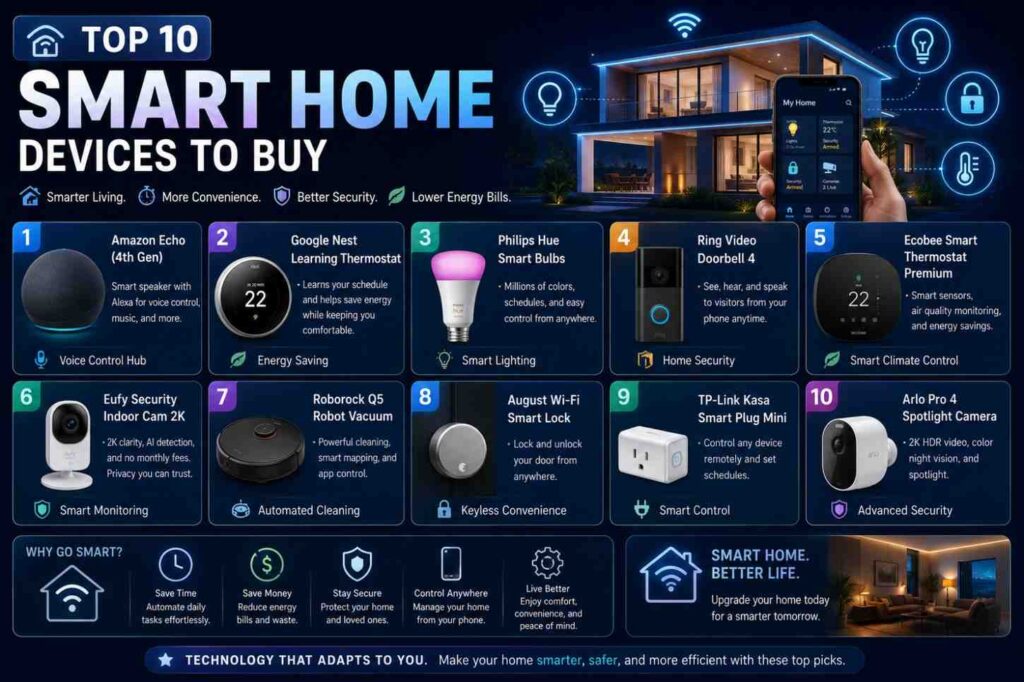
Top 10 Smart Home Devices to Buy in 2026
Smart homes are no longer futuristic concepts—they are practical, accessible, and increasingly essential in modern living. The Top 10 Smart Home Devices to Buy in 2026 reflect how quickly technology has evolved toward automation, intelligence, and seamless connectivity. Today’s smart home ecosystem is powered by AI, IoT integration, and voice-controlled systems that simplify everyday routines.
In 2026, users expect more than just remote control—they expect predictive automation, energy efficiency, and strong security. From smart speakers that act as home assistants to AI-driven security cameras and adaptive thermostats, these devices are reshaping how we interact with our living spaces. Modern smart home systems can now learn user behavior, adjust settings automatically, and even anticipate daily needs without manual input.
Another major shift is the growing integration between devices. Smart lights, locks, cameras, and appliances now work together within unified ecosystems, allowing homeowners to control everything from a single app or voice assistant. This level of connectivity not only improves convenience but also enhances safety, energy management, and overall lifestyle efficiency.
At the same time, affordability and accessibility have improved significantly, making smart home technology available to a much wider audience. What was once considered luxury technology is now becoming a standard feature in many households around the world. As innovation continues, smart homes are evolving into fully automated environments that blend comfort, security, and intelligence.
| Smart Device Category | Core Function | AI / Automation Level | Connectivity Type | Primary Benefit | Best Use Case Scenario |
|---|---|---|---|---|---|
| Smart Speakers | Central voice control hub | High (AI-driven routines) | Wi-Fi / Bluetooth | Hands-free control | Managing full smart home ecosystem |
| Smart Security Cameras | Surveillance & monitoring | High (AI motion detection) | Wi-Fi | Real-time safety alerts | Home security & remote monitoring |
| Smart Doorbells | Visitor identification | Medium-High (AI alerts) | Wi-Fi | Entry security control | Package & visitor tracking |
| Smart Thermostats | Temperature automation | High (learning-based AI) | Wi-Fi | Energy optimization | Heating/cooling efficiency |
| Smart Lighting Systems | Lighting automation | Medium (rule-based AI) | Wi-Fi / Zigbee | Energy saving & ambiance | Smart mood-based lighting |
| Smart Locks | Door access control | Medium | Wi-Fi / Bluetooth | Keyless entry | Secure home access management |
| Smart Sensors | Motion/environment detection | Medium | Zigbee / Wi-Fi | Trigger automation routines | Security automation triggers |
| Smart Plugs | Appliance control | Low-Medium | Wi-Fi | Remote power control | Energy management of devices |
| Smart TVs | Entertainment automation | Medium | Wi-Fi | Integrated media control | Home entertainment systems |
| Smart Home Hubs | Device integration center | Very High | Multi-protocol | Unified ecosystem control | Full smart home orchestration |
What Are Smart Home Devices and Why They Matter in 2026
Smart home devices are interconnected electronic systems that allow users to control and automate various household functions such as lighting, temperature, security, entertainment, and appliances. These devices rely on Wi-Fi, Bluetooth, and IoT (Internet of Things) networks to communicate with each other and with users through mobile applications or voice assistants. Together, they create a connected environment where everyday tasks can be managed with minimal effort.
In 2026, smart home technology has become significantly more advanced due to breakthroughs in artificial intelligence, machine learning, and edge computing. Instead of functioning as isolated gadgets, modern devices now operate as part of a unified ecosystem that can learn user behavior and adapt automatically. This shift has transformed smart homes from simple remote-controlled setups into intelligent, self-managing environments that improve comfort, efficiency, and convenience.
Definition of Smart Home Technology
Smart home technology refers to any electronic device or system that can be controlled remotely or operate automatically based on user-defined rules or AI-driven insights. These devices include smart speakers, thermostats, security cameras, lighting systems, door locks, and even kitchen appliances that respond to voice commands or app-based controls.
Most modern smart home systems are connected through centralized platforms such as Amazon Alexa, Google Home, or Apple HomeKit. These platforms allow users to control multiple devices from a single interface, reducing complexity and making home management more seamless. This level of integration enhances convenience while also improving energy efficiency and security.
Role of AI and IoT in Smart Homes
Artificial Intelligence (AI) and the Internet of Things (IoT) form the core foundation of modern smart home systems. AI enables devices to analyze user behavior, recognize patterns, and make intelligent decisions, while IoT ensures smooth communication between connected devices across the home. For example, a smart thermostat can automatically adjust temperature based on daily routines without any manual input.
This combination of AI and IoT significantly improves efficiency, reduces energy consumption, and enhances user experience. Many households now rely on automation for routine tasks such as adjusting lighting, managing home security, and controlling appliances, creating a more effortless and responsive living environment.
Why 2026 Is a Turning Point
The year 2026 represents a major turning point for smart home technology due to increased affordability, accessibility, and widespread adoption. Devices that were once considered premium or luxury products are now becoming standard features in many homes around the world. Improved manufacturing and competition have made smart technology more cost-effective than ever before.
At the same time, advancements in interoperability and standardization have made it easier for devices from different brands to work together within a single ecosystem. Stronger privacy regulations and improved encryption technologies have also increased user trust, encouraging more people to adopt smart home systems. As a result, smart homes are rapidly becoming a mainstream part of modern living.
How to Choose the Right Smart Home Devices
Choosing the right smart home devices requires careful planning and a clear understanding of compatibility, usability, security, and long-term scalability. With hundreds of products available on the market, selecting individual devices randomly can lead to connectivity issues and limited automation. Instead, focusing on a unified ecosystem ensures smoother performance and a more seamless smart home experience.
A well-designed smart home setup allows all devices to communicate effectively, reducing technical problems and improving automation efficiency. When devices are properly integrated, users can control multiple systems at once, create automated routines, and enjoy a more convenient and connected lifestyle. This makes the selection process just as important as the technology itself.
| Ecosystem | Parent Company | AI Strength | Device Compatibility | Privacy Level | Best Feature | Ideal For |
|---|---|---|---|---|---|---|
| Alexa Ecosystem | Amazon | High | Very Wide | Medium | Voice automation routines | Budget + mass smart homes |
| Google Nest Ecosystem | Very High | Wide | Medium-High | AI learning + search intelligence | AI-powered smart homes | |
| Apple HomeKit | Apple | Medium-High | Limited but premium | Very High | Strong privacy + security | Privacy-focused users |
| Samsung SmartThings | Samsung | High | Wide (multi-brand) | Medium | Cross-device integration | Mixed-brand smart homes |
| Matter Standard Ecosystem | CSA Alliance | Growing AI support | Universal compatibility | High | Cross-platform integration | Future-proof smart homes |
Ecosystem Compatibility
Ecosystem compatibility is one of the most important factors when building a smart home. Most smart devices are designed to work within specific ecosystems such as Amazon Alexa, Google Nest, or Apple HomeKit. These platforms act as central hubs that connect and control all compatible devices in a unified system.
Choosing a single ecosystem helps avoid connectivity issues and ensures smoother automation between devices. While it is possible to mix different ecosystems, doing so can limit advanced automation features and create unnecessary complexity. For the best experience, it is generally recommended to stay within one primary ecosystem.
Security and Privacy Features
Security is a critical consideration in any smart home setup because connected devices constantly transmit data over networks. Reliable smart devices should include strong encryption protocols, regular firmware updates, and secure authentication methods to protect against unauthorized access. This is especially important for devices like cameras, locks, and voice assistants.
Users should also look for privacy controls such as microphone disable options, camera shutters, and customizable data-sharing settings. Choosing brands with strong security reputations helps reduce the risk of cyber threats and ensures that personal information remains protected.
Budget and Scalability
A smart home does not need to be built all at once, and most users start with basic devices such as smart speakers, lighting systems, or plugs. Over time, they gradually expand into more advanced systems like home security, climate control, and automation hubs. This step-by-step approach makes smart home adoption more affordable and manageable.
Scalability is essential because it ensures the system can grow without requiring users to replace existing devices. A well-planned setup allows new devices to be added easily, creating a flexible and future-ready smart home ecosystem that evolves with user needs and technological advancements.
Top 10 Smart Home Devices to Buy in 2026
These devices represent the most impactful technologies for modern households in 2026, focusing on automation, security, energy efficiency, and everyday convenience. As smart home ecosystems become more advanced, these tools are no longer optional luxury items but essential components of connected living. They work together to create a seamless environment where users can control and automate nearly every aspect of their home.
Modern smart home devices are designed to integrate with AI-powered systems, allowing them to learn user behavior and respond automatically. This means homes are becoming more efficient, secure, and personalized over time. From voice-controlled assistants to intelligent security systems, these devices define the foundation of a fully connected lifestyle.
Smart Speakers & Voice Assistants
Smart speakers act as the central hub of modern smart homes, enabling voice control, automation, reminders, and media management. They serve as the primary interface between users and connected devices, allowing seamless control of lighting, entertainment systems, appliances, and even security features through simple voice commands.
In 2026, smart speakers are more intelligent than ever, with improved natural language understanding and contextual awareness. They can manage multi-step tasks, respond to complex queries, and coordinate multiple devices at once. This makes them an essential component of any smart home ecosystem.
Smart Security Cameras & Doorbells
Smart security cameras and video doorbells provide real-time monitoring and enhanced home protection through AI-powered motion detection and remote access. These devices allow homeowners to view live footage, receive instant alerts, and communicate with visitors from anywhere in the world.
Advanced features such as facial recognition, package detection, and cloud-based recording have significantly improved home security. These systems also integrate with alarms, smart locks, and lighting systems to create a fully responsive security network that reacts instantly to potential threats.
Smart Lighting, Thermostats & Locks
Smart lighting systems help improve energy efficiency and allow users to customize brightness, color, and schedules based on daily routines. Smart thermostats automatically adjust indoor temperatures for comfort and energy savings, learning user preferences over time to optimize climate control.
Smart locks provide secure, keyless entry using mobile apps, PIN codes, or biometric authentication. When combined, these three categories form the core foundation of a smart home, offering enhanced comfort, improved safety, and greater control over household environments.
Comparison Table of Top Smart Home Devices
This comparison highlights the key differences between major smart home devices based on their core functions, ecosystem compatibility, and overall value. As smart home technology continues to evolve in 2026, understanding these differences helps users choose the right combination of devices for automation, security, and energy efficiency. Each category serves a specific purpose, but the best smart homes combine multiple devices into a single connected ecosystem.
By comparing features, integration levels, and long-term benefits, users can better evaluate which devices fit their lifestyle needs. Some devices focus more on convenience and control, while others prioritize safety or cost savings, making it important to balance performance with practicality.
Device Features Overview
Smart home devices are designed with different primary functions, depending on whether they focus on automation, security, entertainment, or energy management. For example, smart speakers act as control hubs, security cameras focus on monitoring and safety, while thermostats and lighting systems optimize comfort and energy usage. Each device contributes differently to the overall smart home experience.
In modern smart home setups, many devices are becoming multifunctional, combining several features into a single product. Smart speakers now control entire ecosystems, while advanced cameras offer motion detection, facial recognition, and cloud storage, making homes more intelligent and responsive.
Ecosystem Integration Comparison
Ecosystem integration plays a major role in determining how well smart devices work together. Most devices are built to operate within major platforms such as Amazon Alexa, Google Nest, or Apple HomeKit. These ecosystems act as central control systems, allowing users to manage multiple devices through a single app or voice assistant.
Strong integration ensures smoother automation, better synchronization, and fewer compatibility issues across devices. However, mixing ecosystems can sometimes limit advanced features or require extra configuration, so choosing a primary ecosystem often leads to a more seamless smart home experience.
Value for Money Analysis
When evaluating value for money, smart thermostats and lighting systems are often the most cost-effective long-term investments. These devices help reduce energy consumption by automatically adjusting usage based on habits, schedules, and environmental conditions.
Although some smart devices require higher initial investment, they provide long-term savings through efficiency and automation. Security devices and smart hubs may not directly reduce costs but add significant value through convenience, protection, and improved quality of life.
| Device Type | Function | Key Benefit | Best Ecosystem |
|---|---|---|---|
| Smart Speaker | Central control | Voice automation | Alexa / Google |
| Smart Camera | Security monitoring | Real-time alerts | Google Nest |
| Smart Lock | Access control | Keyless entry | Apple HomeKit |
| Smart Thermostat | Climate control | Energy savings | Google Nest |
| Smart Lighting | Automation | Efficiency & comfort | Alexa ecosystem |
Installation and Setup Guide for Smart Homes
Setting up a smart home requires a structured approach to ensure all devices work together efficiently. A proper installation process not only improves performance but also reduces connectivity issues and enhances long-term reliability. In 2026, most smart home devices are designed for easy installation, but correct setup is still essential for full functionality.
A well-planned setup also ensures that automation features run smoothly across different devices. By carefully configuring each component and connecting them to a unified system, users can create a seamless smart home experience that is both efficient and easy to manage.
Step-by-Step Installation Process
The installation process begins by selecting a central ecosystem such as Amazon Alexa, Google Home, or Apple HomeKit. This step is important because it determines how all devices will communicate and function together. After selecting an ecosystem, users can install individual devices using their official mobile applications.
Most modern devices use QR code-based setup systems, making installation quick and user-friendly. Users simply scan the code, connect the device to Wi-Fi, and follow on-screen instructions. This streamlined process reduces technical complexity and allows even beginners to set up smart home systems easily.
Connecting Devices to Ecosystem
Once devices are installed, the next step is to connect them to a single ecosystem for centralized control. Platforms like Alexa or Google Home allow users to manage all connected devices from one dashboard or through voice commands.
This integration ensures smooth communication between devices, enabling features like automation, scheduling, and remote access. When properly connected, users can control lighting, security, and appliances from a single app, creating a fully unified smart home environment.
Testing Automation Routines
After connecting all devices, it is important to test automation routines to ensure everything functions correctly. Common routines include “Away Mode,” which turns off lights and activates security systems, and “Night Mode,” which adjusts lighting and locks doors automatically.
Testing these routines helps identify setup issues and ensures that all devices respond as expected. Once optimized, automation significantly improves convenience, security, and energy efficiency, making daily home management more effortless and intelligent.
Benefits of Smart Home Devices in 2026
Smart home devices in 2026 offer a wide range of benefits that go beyond basic automation. They are designed to improve daily living by making homes more efficient, secure, and convenient. With advancements in AI and IoT, these systems are now capable of learning user behavior and adapting automatically to individual needs.
As a result, smart homes are no longer just about control—they are about intelligent living. From reducing energy consumption to enhancing safety and enabling remote management, these devices are transforming how people interact with their living spaces in practical and meaningful ways.
Energy Efficiency and Cost Saving
One of the most important benefits of smart home devices is improved energy efficiency. Smart thermostats, lighting systems, and appliances automatically adjust their usage based on occupancy, time schedules, and user preferences, helping to reduce unnecessary energy consumption.
This optimization leads to lower electricity and utility bills over time while also supporting environmentally friendly living. By minimizing waste and improving resource management, smart homes contribute to both financial savings and sustainable lifestyle choices.
Enhanced Home Security
Smart home technology significantly improves home security through AI-powered surveillance systems, smart locks, motion sensors, and real-time alerts. These devices continuously monitor the home environment and detect unusual activity instantly.
In addition, users can access live camera feeds, receive notifications, and control security systems remotely. This multi-layer protection system provides greater peace of mind and ensures stronger safety compared to traditional security methods.
Convenience and Remote Access
Convenience is one of the biggest advantages of smart home systems, as users can control almost every device from anywhere using mobile applications or voice assistants. This includes managing lighting, temperature, security, and appliances with just a few taps or commands.
Remote access also allows users to monitor and adjust their home settings while traveling or working, ensuring complete control at all times. This level of flexibility makes daily life simpler, faster, and significantly more efficient.
Future Trends in Smart Home Technology (2026 and Beyond)
Smart home technology is rapidly evolving toward more intelligent, automated, and deeply connected systems. In 2026 and beyond, homes will no longer rely on individual devices working separately, but instead on fully integrated ecosystems powered by AI, IoT, and advanced cloud computing. These innovations are shaping homes that are more responsive, efficient, and personalized than ever before.
As technology continues to advance, the focus is shifting from manual control to predictive intelligence. Future smart homes will not only respond to commands but also anticipate user needs, optimize energy usage, and enhance security automatically. This marks a major transition toward fully autonomous living environments.
AI-Powered Predictive Automation
AI-powered predictive automation will allow smart home devices to learn user behavior patterns and adjust settings automatically without manual input. For example, lighting, temperature, and security systems will adapt based on daily routines, weather conditions, and personal preferences.
Over time, these systems will become more accurate as they continuously analyze user data and refine their predictions. This will create a highly personalized living experience where homes actively support comfort, efficiency, and convenience without requiring constant user interaction.
Full Home Integration Systems
The future of smart homes lies in complete system integration, where all devices function as part of a unified intelligent network. Instead of operating independently, smart speakers, security systems, appliances, and sensors will communicate seamlessly with each other.
This level of integration will enable advanced automation scenarios such as fully coordinated “home modes” that adjust lighting, security, entertainment, and climate simultaneously. As a result, managing a home will become simpler, more efficient, and highly synchronized.
Privacy and Data Security Improvements
As smart homes become more connected, privacy and data security are becoming critical priorities. Future systems will implement stronger encryption methods, secure authentication protocols, and improved data protection frameworks to safeguard user information.
In addition, decentralized processing and edge computing will reduce reliance on cloud storage, minimizing risks associated with data breaches. These improvements will help build user trust and ensure that smart home technology remains safe, reliable, and widely adoptable.
Frequently Asked Questions
Frequently asked questions are designed to quickly address the most common doubts and concerns users have about smart home devices. Instead of going through the entire guide, this section provides clear and concise answers that help readers understand key concepts in a simple way. It is especially useful for beginners who want quick clarity before making purchasing or setup decisions.
This section also highlights the most important practical aspects of smart home technology in 2026, including compatibility, security, cost, and usability. By summarizing essential information in an easy-to-read format, FAQs make it easier for users to make informed decisions and build efficient smart home systems.
What are the best smart home devices in 2026?
Smart speakers, security cameras, smart thermostats, lighting systems, and smart locks are considered the best smart home devices in 2026. These devices form the foundation of a connected home by improving automation, security, and energy efficiency.
They are widely used because they integrate with major ecosystems and offer advanced features such as AI automation, remote access, and real-time monitoring, making everyday life more convenient and efficient.
Are smart home devices worth it in 2026?
Yes, smart home devices are highly worth it in 2026 because they significantly improve convenience, reduce energy costs, and enhance home security. They allow users to automate daily tasks and manage their homes more efficiently.
Over time, these devices also provide long-term savings through energy optimization and better resource management, making them a practical investment for modern households.
Which smart home ecosystem is best?
The best smart home ecosystem depends on user needs. Amazon Alexa offers wide compatibility with third-party devices, making it highly flexible. Google Nest provides strong AI-powered features and seamless integration with Google services.
Apple HomeKit, on the other hand, focuses heavily on privacy and security, making it ideal for users who prioritize data protection and a closed, secure ecosystem.
How do I start building a smart home?
The best way to start building a smart home is by beginning with a smart speaker or voice assistant hub. This acts as the central control system for all future devices.
After that, users can gradually expand their setup by adding compatible devices such as smart lights, plugs, cameras, and thermostats, ensuring smooth ecosystem integration.
Do smart home devices work without internet?
Some basic functions may work without an internet connection, such as local device control or pre-set routines. However, most advanced features require internet access to function properly.
Cloud-based services, remote control, and AI-powered automation typically depend on connectivity, making a stable internet connection essential for full performance.
Are smart homes secure from hacking?
Modern smart home systems use encryption, authentication, and regular security updates to reduce the risk of hacking. However, no system is completely immune to threats.
Users also play an important role by using strong passwords, enabling two-factor authentication, and keeping devices updated to maintain strong security.
Can I mix different brands in a smart home?
Yes, it is possible to mix different brands in a smart home, but compatibility depends on ecosystem support such as Alexa, Google Home, or Apple HomeKit.
Using devices within the same ecosystem generally provides better integration, smoother automation, and fewer connectivity issues compared to mixing multiple platforms.
Conclusion
Smart home technology is rapidly transforming modern living by combining automation, artificial intelligence, and seamless device connectivity. In 2026, these systems are no longer just optional upgrades but essential tools that enhance comfort, improve security, and increase energy efficiency in everyday life.
As innovation continues, smart homes are becoming more intelligent, adaptive, and user-friendly, allowing people to manage their environments with minimal effort. From lighting and security to climate control and entertainment, everything is now part of a connected digital ecosystem.
Key Takeaways
Smart home technology is fundamentally changing how people interact with their living spaces by introducing automation, AI-driven decision-making, and improved system integration. These advancements help reduce manual effort while increasing overall efficiency and convenience.
The key takeaway is that smart homes are not just about technology—they are about creating a more responsive and personalized lifestyle. As systems become more advanced, they will continue to simplify daily routines and improve quality of life.
Final Thoughts
Building a smart home requires careful planning, ecosystem selection, and gradual expansion, but the long-term benefits make it a worthwhile investment. Starting with basic devices and scaling over time ensures better compatibility and smoother performance.
Ultimately, smart homes offer a powerful combination of convenience, control, and efficiency. With consistent setup and thoughtful integration, users can create a fully connected environment that adapts to their needs and enhances everyday living.